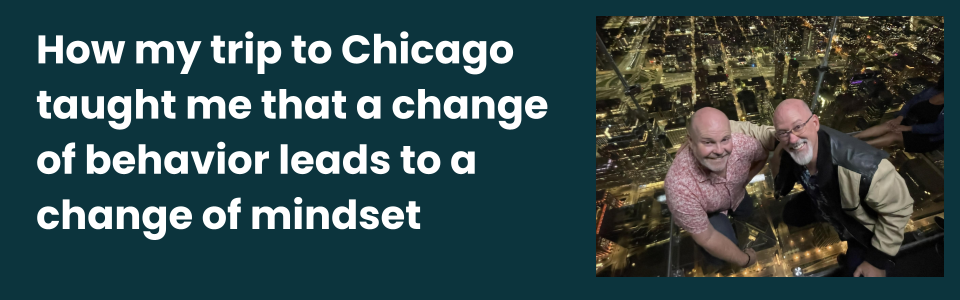
This is a photo of Dave and me standing on a balcony with a glass floor…103 floors above a crowded street in Chicago. What does this have to do with professional development? Read on.

Changing how we teach is one of the most significant challenges in education. For decades, we have followed a standard script for professional development: we try to change a teacher’s heart and mind first, hoping their classroom behavior will follow. We host workshops, share research, and use logic or emotional appeals to convince educators that a new method is better. But as Thomas Guskey points out in his research, this “mindset-first” approach is exactly backward for most experienced teachers.
To truly transform education, he says we need to “flip the script” on change. Guskey’s Model of Teacher Change suggests that significant shifts in a teacher’s attitudes and beliefs don’t happen in a seminar room; they happen as a result of a change in teacher behavior in the classroom.
In short

So which is it? Does a change of mindset lead to a change of behavior? Or does a change of behavior lead to a change of mindset?
Mystery solved
I recently saw the answer to this mystery this firsthand on a trip to the top of the Willis Tower (formerly called the Sears Tower) in Chicago. Built in 1973 the Willis Tower was the tallest building in the world for 25 years. What many people don’t know is that in 2009 they added a retractable glass balcony which extends out 4 feet from the building. “The Ledge”, as it is called, enables those brave enough to stand on the glass floor to look straight down from the 103rd floor, overlooking South Wacker Drive.
For some of the nervous visitors, once they were told the glass floor was safe and would not break, they eagerly stepped onto the glass floor to peer down the 103 floors. For these folks a change of mindset (the floor won’t break?) led to a change of behavior (let me get on that ledge).
For the remainder of the nervous visitors, no amount of logic, coaching, or words of affirmation was going to get them to stand on the glass balcony. Take a look at the photo of me and my good buddy Dave on the glass balcony. It might be hard to see, but if you look closely, you will see that both of my feet are on the glass, while only Dave’s right foot is on the glass. His left foot is still on the “regular” floor just outside the frame of the photo. Why is this? There was no way I was going to convince Dave to change his mindset in order to get him onto the glass. Instead, he began by lying flat on the carpet and stretching his arm onto the glass floor. Then he put both arms on the glass with the rest of his body safely on the carpet. Eventually, he rotated his body and placed a foot on the glass. Then a whole leg.
Each change of his behavior—placing new body parts onto the glass—led to an incremental change in his mindset. After several minutes, he finally was able to take the photo you see here.
For Dave…and the many people like him…a change of behavior (hey, I can put my leg on the glass!) lead to a change of mindset (I am not going to fall 103 floors!).
This is exactly how Guskey says real change in the classroom will happen. First change teacher behavior, which then leads to a change in their mindset.

The Real Sequence of Change
The traditional model assumes that if we change a teacher’s beliefs, their practice will change, leading to better student outcomes. Guskey proposes an alternative temporal sequence:
- Professional Learning: Teachers are introduced to new, research-based practices.
- Change in Classroom Practices: Teachers implement these new techniques in their specific classroom contexts.
- Change in Student Learning Outcomes: Teachers see clear, documented evidence that their students are learning better, behaving more positively, or becoming more engaged.
- Change in Teachers’ Attitudes and Beliefs: Only after seeing this success firsthand do teachers truly believe in the new approach and become committed to it.
Teachers are inherently pragmatic. They judge the value of any new strategy by one primary metric: “Does this help my students?”. If a teacher tries a new instructional approach and sees a struggling student suddenly “get it,” their belief system shifts because their experience has changed. Without that evidence of success, even the most logical arguments for change will likely be abandoned as soon as the workshop ends.
Why Mindset-First Approaches Struggle
I now understand that for too many years I was designing my PD sessions to create “cognitive dissonance” to force a change in belief—using confrontation, mental manipulation, or heart-wrenching stories to show teachers why their current methods are “traditional” or ineffective. However, psychology tells us that when our core beliefs are challenged, we often ignore the new information or twist it to fit our current view rather than changing ourselves. Logic rarely changes deep-seated perceptions; only experience does.
Making Change Stick
So what do I do now? I have come to accept that experience drives belief, which means how I support teachers makes a profound difference in whether teachers will try new instructional practices. I start with helping teachers recognize that change is a gradual, difficult, and often threatening process. Then I coax teachers into trying a new instructional move in the classroom, with their students, and with me right at their side supporting them each step of the way. This is the pedagogical version of my encouraging Dave to put his arm on the glass floor of “The Ledge”.
When teachers try something new, they risk failure, which is a scary prospect for someone deeply committed to student success. To bridge this gap, my coaching moves focus on three critical pillars:
- Evidence and Feedback: Teachers need regular, quick feedback on student progress. This doesn’t mean waiting months for standardized test scores; it means looking at classroom assessments, student engagement, and even the “light bulb moments” that happen in daily lessons. I make sure teachers see the DIRECT result of their efforts to change their behavior. I might say to the teacher, “Hey look at the tape diagram Javier just drew! That is only because you tried using the Numberless Word Problem routine!” Teachers need to see the IMMEDIATE benefit of their brave attempt to try something new.
- Mutual Adaptation: There is no such thing as a “one-size-fits-all” reform. Successful change requires a balance between following a program with fidelity and adapting it to fit the unique needs of a specific classroom and its students. The new instructional skill being implemented should be customized on a per teacher basis. While one teacher might be working on the Three Read Protocol another is deepening their understanding of the CRA instructional approach.
- Continued Support and Pressure: Professional learning is a process, not an event. Teachers need ongoing follow-up and support to navigate the “implementation dip” where things feel messy before they get better. Sometimes, a bit of gentle pressure is also necessary to ensure persistence through these challenging stages. As a coach my role is to provide the teacher with continued support that will allow her to stick with the change in behavior.
Ultimately, if we want teachers to believe that every student can succeed, we have to give them the tools and the experiences that prove it’s true. When we change the experience, the mindset follows naturally.
.
.
.