Take a moment to solve this problem using any method you wish…
A farm has a total of 480 llamas and alpacas.
\(\frac{4}{5}\) of the number of llamas at the farm are equal to \(\frac{4}{7}\) of the number of alpacas.
How many more alpacas than llamas are there?
I’ll wait.
.
.
.
.
.
Can I move on?
It is likely you tried some sort of algebra.
If so, it might have looked a little like this…
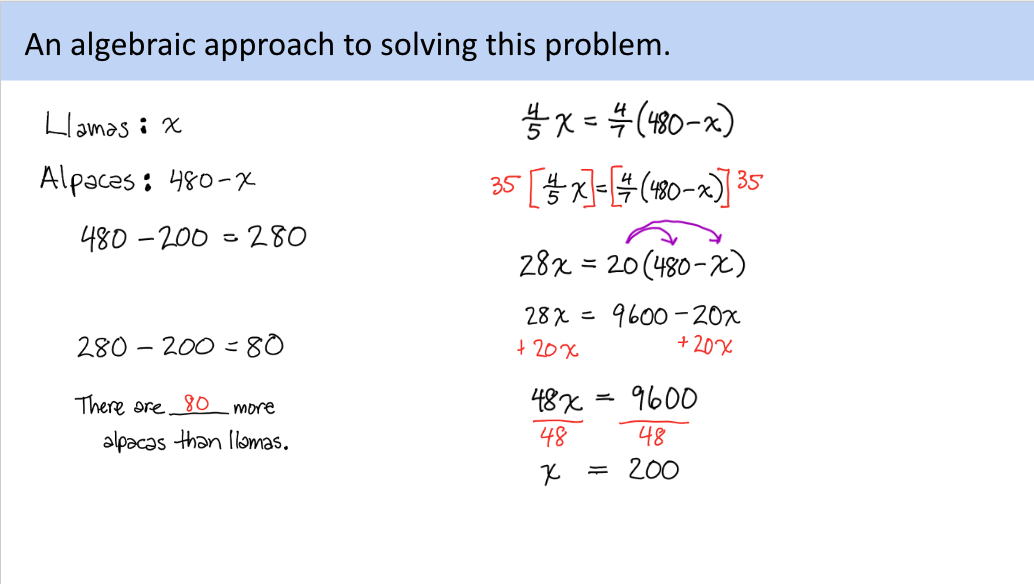
Gross.
Using tape diagrams, it would look like this…
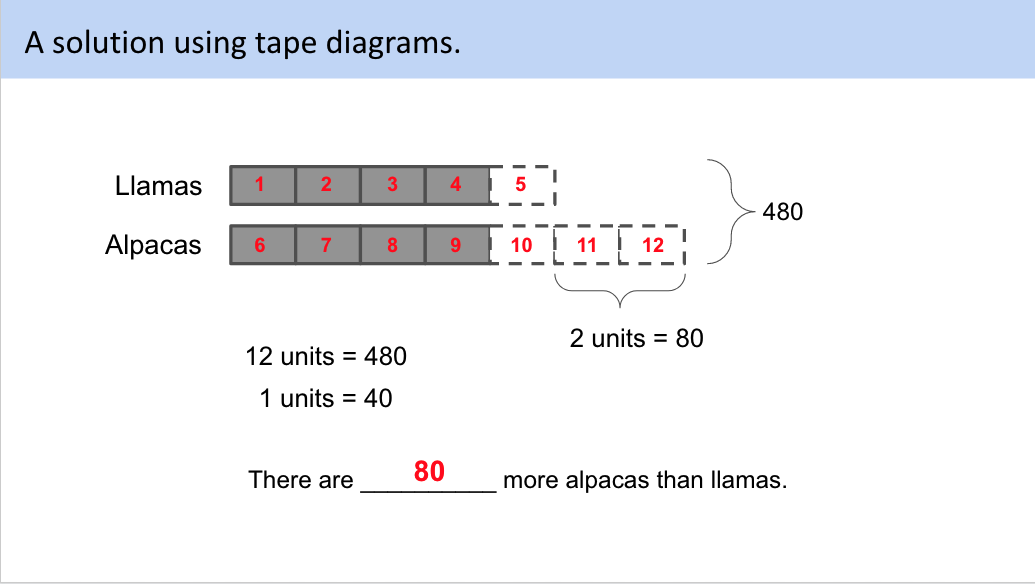
Take a moment to look deeply at the tape diagram above.
What do you notice? What do you wonder?
.
.
.
Using tape diagrams, this problem requires no mathematics beyond an understanding of 4th grade division and 4th grade fractions. The SAME problem can be solved using fancy algebra or simple arithmetic.
Tape diagrams are visual representations that allow students to see the underlying mathematical truths of the abstract mathematics we teach. Let’s look at the “simple” fraction concept of converting an improper fraction into a mixed number, for example.
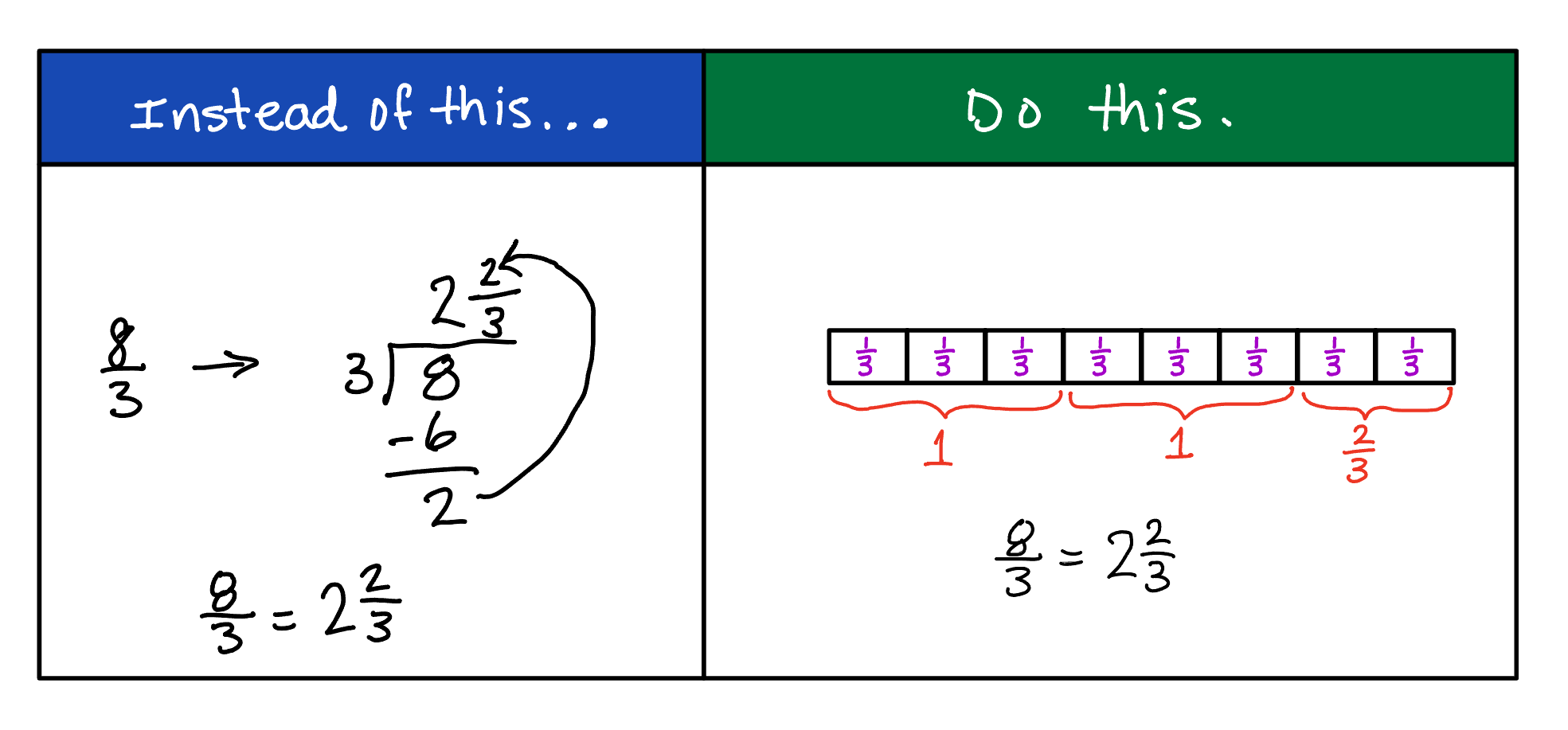
A traditional approach to this concept would have the teacher explaining that the fraction 8/3 also means to divide 8 by 3. Why? Don’t ask…just do it. Then the teacher goes through some sort of song and dance explaining why the top number goes into the “house” and the bottom number goes outside.
The cowboy rides the horse. Of course, the cowboy gets to go into the house…not the horse.
The top dog gets the house.
What other lame mnemonics have you heard?
Then the teacher continues the fraction conversion by relying on the 4th grader’s shaky understanding of long division. What do we do with the remainder? We just swoop it up to the top and bring over the three as the denominator. Why? Don’t ask…just do it.
In contrast, we use a tape diagram to represent 8 thirds. We use brackets or circles to show that 3 thirds equals 1 whole. We have enough thirds left over to show another 1 whole. We have 2 thirds left over. If at any time a students asks WHY, the teacher can produce a more meaningful response than “Don’t ask…just do it.”
Why do we draw 8 boxes? Because we have 8 thirds and each unit represents a third.
Why do we put a bracket around 3 thirds? Because 3 thirds equals 1 whole.
So what is the lesson of this short blog post? Tape diagrams are visual representations that make math make sense. Tape diagrams increase access to rigorous mathematics for ALL students.
But here is the dilemma:
Virtually no teachers in the classroom today learned mathematics through regular use of the tape diagram model. And yet, we expect teachers to develop an understanding of tape diagrams on their own, so they can then integrate them into their daily lessons for their students.
This is a remarkably unfair and unreasonable expectation to place on teachers. Instead, site leaders and district leaders need to acknowledge the elephant in the room that for many, many teachers we are expecting them to teach mathematics that they themselves do not yet understand.
How do we fix this? Provide mathematics content coaches for all teachers.
There is lots of research connecting a teacher’s math content knowledge, their mathematical knowledge for teaching, and their strong use of student discourse and math vocabulary to an increase in student mathematical achievement.
Math content knowledge:
This refers to the ability to get the answer in any fashion. Can the teacher convert 8/3 into a mixed number? Yes? Check.
While most teachers know most of the math they teach, it is a common experience for our mathematics instructional coaches to be pulled aside by a teacher who sheepishly asks us to explain how to do some sort of mathematics they about to teach in the coming days.
What to do: Leaders need to create time in the teachers’ busy schedules for them to do math together. Perhaps a grade level team can print an FIAB from the CAASPP website and complete it in its entirety. Teachers can discuss the answers and the variety of ways in which each problem can be solved. Math content coaches can provide additional support…especially with tape diagrams…to help the grade level grow as mathematicians.
Math knowledge for teaching:
I have written extensively about it here, but MKT is the teacher’s ability to
- identify incorrect answers and faulty methods and analyze errors efficiently and fluently, just like mathematicians do in the course of their work.
- make sense of students’ non-standard procedures, even when they have never encountered them before.
- provide justification for the steps in algorithms and procedures, meanings for terms, and explanations for concepts.
- make strategic choices of mathematical representations and examples when illustrating ideas.
- sequence student examples to create a trajectory towards the teaching of algorithms.
MKT builds upon the teacher’s math content knowledge enhance their instruction and ensure all students can successfully learn mathematics. Teachers with MKT understand how to use tape diagrams to support students explain their own thinking.
What to do: Leaders need to find mathematics instructional coaches who can support teachers in developing their MKT. This is much more challenging than merely plucking a teacher from her classroom and anointing her “math coach”. Learning MKT deeply enough to then support other teachers requires years of experience. Your local county office of education likely has math coordinators available to support MKT in your community.
Math vocabulary in the classroom:
In a recent study, researchers at Harvard University, the University of Maryland College Park, and Stanford University found that while math vocabulary in teacher talk does not substantially cause students to uptake mathematical vocabulary, teachers who more frequently model mathematical vocabulary are more effective at raising student test scores.
This is much. Much more than just creating a word wall and requiring students to use those words in conversation. Rather, when teachers model proper vocabulary it opens a sort of portal into the conceptual understanding of the mathematics. The way I think of it is if I can name it, then students can see it, which leads to learning it. Name it → See it → Learn it.
See it: this is, again, where tape diagrams play an essential role in learning math vocabulary, which subsequently leads to math achievement.
TL;DR
Tape diagrams are an essential teaching tool, but too few teachers are comfortable with tape diagrams. To support teachers in their understanding of tape diagrams, site and district leaders need to create opportunities for teachers to do math together. To amplify the teacher growth, leaders need to ensure teacher have access to math-specific instructional coaches who can lead the way.
Tape diagrams make mathematics visible, logical, and accessible—but tools alone don’t transform classrooms. Teachers do. And if we want teachers to confidently use representations they were never taught, we must stop pretending they can simply “figure it out” on their own. Investing in math content coaches is not an optional add‑on; it is the infrastructure required for meaningful change. When teachers learn mathematics together, supported by experts who understand both content and pedagogy, students benefit. If we want all students to experience math that makes sense, we must first ensure all teachers experience that same clarity.
.
.
.